


Poetry and education


Dear Readers and Friends,
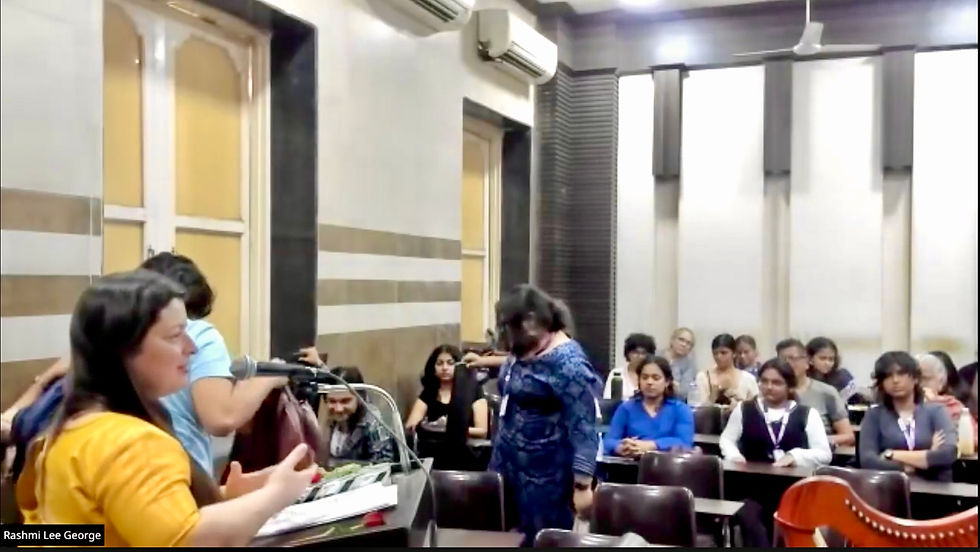
I am very much grateful for the invitation to attend the Poetry Day, in honour of Eunice de Souza, as a Chief Guest, organized by the English Department of the St. Xavier College in Mumbai, one of the most prestigious institutions in India, founded by the Jesuits in 1869. It is also said to be the Indian "Hogwarts", for its stairs, and outstanding architecture. Professor Rashmi, Stuti, and Prasita are enthusiastic of the value of Poetry and Literature in our way to be in the world. Father Keith, our dean, was in Indonesia – meeting also new Brazilian friends, by the way!
Eunice de Souza was a beloved professor and poet of Saint Xavier, full of personality, who influenced many students during her tenure. Professor Agnelo Menezes, the first layperson to direct St. Xavier, was her friend and student, and also Hannah Munir, her former student and writer, the illustrious doctor Christopher de Souza, her friend, Mr. Fernandez, and the brilliant students of St. Xavier joined us as speakers.
I prepared this speech I share with my readers, and a poem that maybe Eunice de Souza could have enjoyed.
And there was still space for playing a bit of the harp, as a student like those young poets; and to sing. Videos of our celebration at the end, memories that make this experience hard to forget.
Have a good reading!
With love,
Ana Paula Arendt.

Poetry and Education
(Speech delivered at Eunice de Souza Memorial Day, 1st August 2026, St. Xavier College)
I would like to thank Professors Prasita, Professor Rakshmi, and Professor Stuti for their kind invitation. I would also like to thank the students and staff who welcomed me today. It is a privilege and honor to join you today in celebrating the life and work of the remarkable poet Eunice de Souza.
Reading Eunice’s poetry has been a moving experience. I have recently begun translating some of her poems into Portuguese, and, unexpectedly, they reminded me of my own country. Like the Brazilian Modernists, Eunice seemed less concerned with poetic ornament than with truth. I have the impression that she believed poetry should be honest and reveal life as it is, in the language people actually speak. That courage gave her voice an enduring freshness.
Her independence of mind and unwavering fidelity to herself continue to inspire us. She reminds us that genuine poetry is born not from conformity, but from the quiet courage to see reality without fear.
As I have come to know India, I have also come to admire you, young people. I came to understand that many students carry enormous expectations—not only their own, but also those of their families.
Competition can become so intense that it narrows our imagination, making us believe that only a few paths are worthy of pursuit. We live in a world where institutional structures can sometimes create artificial bottlenecks, forcing millions of brilliant minds to invest their families' entire patrimony in a gruelling attempt to secure entry into a painfully narrow set of social roles—such as medicine, engineering, or law.*
This intensity reminds me of the famous "Universe 25" experiment by the American ethologist Dr. John B. Calhoun. In a carefully designed utopia of unlimited resources for each individual, as the population grew, the available space became increasingly compressed, like our big cities. Tragically, the animals began crowding desperately around a single feeder, fighting among themselves while ignoring the availability of the other feeders and the rest of the environment. Social structures fractured, leading to the emergence of what Calhoun called "the beautiful ones"—a segment of the population that withdrew entirely into isolation, shedding all social responsibility, mice licking their fur all day, spending their days grooming themselves. The scientist concluded that a "first death"—the death of the spirit and of social purpose—long preceded the physical demise of the colony.
Why do I evoke this experiment? We can never equate the complexity of human beings with that of mice, for sure. But it invites us to reflect. It reminds us to look beyond individual behavior and to recognize the structural dimensions of social challenges, and institutions.
The endless repetition of studying to gain admission to a prestigious program, without envisioning alternative paths to personal and professional fulfillment, mirrors what Dr. Calhoun described as a "behavioral sink." It made me think that, as human beings, we often crowd ourselves around careers that seem more attractive, following a single path while overlooking the richness of life's many possibilities. Sometimes we also crowd ourselves around the endless repetition of an unsatisfactory reality, returning to the same friction simply because we struggle to imagine a different space.
This is where poetry matters.
Poetry enlarges our vision before it changes our world. It teaches us to see those who remain unseen, to recognize dignity where others perceive only difference, and to preserve the inner freedom that allows us to think beyond our immediate circumstances.
Against this artificial cruelty stands the frank, unvarnished approach of Eunice d’Souza and the true poets. She belongs to a breed of poets who reject the ornamental illusions of status. Such poets teach us to look at life stripped of its social decorations, insisting that human value resides in the unyielding truth of existence, not in the conditional mirrors of institutional prestige.
Not even poetry escapes her sense of reality. In one of her sharpest observations, she wrote:
“Don't Look For My Life In These Poems
Poems have order, sanity,aesthetic distance from debris.
All I've learnt from pain
I always knew (…)”

There is a deep reflection in these verses on the relationship between art, order, and reality. To me, Eunice seems to reject, in these verses, the ornamental illusions of status, even if they are granted by poetry.
She understood that while a rigid system seeks to impose a perfect, artificial order, human worth cannot be kept at an "aesthetic distance" from the messy truth of existence.
She reminds us that our value resides in the enduring reality of who you are, not in the conditional mirrors of institutional prestige.
I also see that Eunice never avoided reality in her poetry, even when it became uncomfortable. In this same spirit, I believe I should share with you a few words about the reality you are living in.
Different nations address the challenge of diversifying educational and career pathways in different ways. Some rely on holistic admissions, evaluating students not only by examination scores but also by volunteer service, letters of recommendation from teachers and researchers, and previous work experience. In doing so, they significantly reduce the singular weight of examination day. Others distribute national examinations throughout the school years, avoiding a single moment of extreme pressure. Many societies and governments also actively value excellence in fields such as art, music, fashion, and technology. Every civilization flourishes when it recognizes many different forms of excellence.
I see that your own society possesses a vast wealth of traditional fields of knowledge that are now being revitalized. The contemporary renewal of Indian identity offers a magnificent opportunity to intentionally create and value new paths, new social roles, and alternative careers. Nations become stronger when they allow every talent to find its place, and this begins with a transformation in the mindset to which we have become accustomed.
You are probably among the most capable minds to work on that challenge because you are students at a prestigious college. Developing your own understanding of what is desirable can change what society comes to value as a successful professional career.
For me, Eunice de Souza remains an important example in the particular situation we have been experiencing in India.
She did not wait for permission to think independently. She found in poetry a place where truth could be spoken with honesty, intelligence, and compassion. There is no greater prestige than being true to oneself.
As a career diplomat, we always emphasize that it is ultimately up to each country to choose its own path.
And let me tell you that before arriving here, I served in many countries. In one of them, student protests chose a path of confrontation, paralyzing the country and trapping society in a cycle of mutual blame from which it was difficult to escape, closing streets and protesting for more than one year. In that context, student movements were constantly encouraged by foreign countries that promised incentives, the greater and more prolonged the controversies became. It seems to me a dangerous path—the relocation of authority—if we do not transform our relationship with authority.
We are not supposed to make judgments about the path each country chooses to solve its problems, as we deal with different peoples and different historical trajectories. There, students found merit and a moral duty in the continuous questioning of authority.
But we can learn from that. I believe that your society allows us to think further in terms of what produces the best collective results and solutions, and not only in terms of fulfilling a moral duty.
I have learned that you are an ancient civilization centered on balance and harmony when controversies arise. I have been learning how you deal with conflict and how you elevate the different choices available. In either case, I would venture to recommend that you always take responsibility for finding the best solutions to the problems you face, finding value in who you are.
As the years go by, I would like to confess to you, as a friend, that it becomes increasingly difficult to keep our eyes fixed on what is true and what is just. When we are surrounded by disappointment, conflict, or failure, it is tempting to believe that goodness no longer deserves our attention.
Yet hope is sustained precisely by those who refuse to stop looking for truth, who continue to defend justice even when results are slow, or not visible. Those who keep acting as though a better society can still be built should never be dismissed as naïve. I have found the Freedom Movement in India to be a remarkable source of inspiration. Every lasting transformation begins with people who choose to persevere before there are reasons for optimism.
If I could leave you with one thought today, it would be this: never allow difficult times to prevent your heart from remaining fixed on what we must protect, loyalty to what we recognize as true, and the ardent desire for what is more just. We must seek what is true. We must defend what is just, even when people around us insist with unwavering certainty that things will never change. The world is always changing, and the places where we live change as we ourselves change.
In doing so, you will not only honor the legacy of Eunice de Souza—you will also help shape the future of your own country.
I am not sure whether there will be enough time for a poem. But I would like to share with you an attempt to remain faithful to what I have found to be true and just.
In Brazil, we also have problems to be solved. We often face situations in which people suffer when authorities fail, as in any other country.
I wrote this poem after witnessing the suffering of two Afro-Brazilian public servants whose lives were profoundly affected by institutional decisions.
Thank you.
WHAT IS POETRY?
Ana Paula Arendt
I saw the morning
made of gentle light and silence,
the stillness between the buildings
where the bird awakens and takes flight.
The façades of the buildings
and the glowing streetlights
still shone brighter than the sun.
And I wished to keep the morning with me.
I saw the star,
through the night, shining like water,
escaping the great luminous city.
I let my body float upon a small stretch of sea
and I asked the star many questions.
The sky and the sea
were vast expanses
within which I existed.
I wished to keep the star with me, too.
I saw the tree, the streets, the cities.
I saw my children growing and laughing.
And I saw the sunlight shining upon their hair,
and upon their bodies.
I wished to keep my children with me.
Does poetry keep everything?
Poetry.
Where everything ceases to be a thing
and becomes something of which I am a part…
The morning, the star, the tree,
the streets, the cities, my children
neither accumulate nor weigh.
I also saw two people.
And suffering dwelt within them.
Wounded.
The wounded were forgotten,
like the cool air and gentle light of morning
while everyone is asleep.
Forgotten too,
like the star that is there every day,
with its light so timid and so gentle,
adorning the night above
the great illuminated avenues.
They were forgotten like the trees
and the gardens slowly turning green,
changing their leaves and flowers
amid the ceaseless movement of cars.
Forgotten like my children,
like the pain in their bodies
when they could not rest in my embrace.
Like the silent pain of exile,
far too distant from the place where they were born,
when they were deported
by people who were powerful and hard:
people with hardened hearts,
people whose knowledge was without mercy.
The two wounded people, too,
were abandonedto their own fate.
Dismissed from their work.
Were they not working?
They still work,
far more than those who remained.
Idle were those who stayed behind,
searching for reasons
why two people who were working
should not remain.
The petty are unyielding in their pettiness,
and it is impossible to make them smaller
than they already are.
Yet even so,
I gather up their pettiness and smallness
to give far greater weight
to everything that breathes of love.
Yes, I gather their gentle radiance,
the radiance of those two magnificent people,
the divine fragrance made of living flesh,
of living thought, of living word,
of a living presence crying outfor some justice,
for some truth.
There is something in the wounded
like the color of the morning,
like the brightness of the star,
like the green of the trees,
like the garden paths,
and like the sun upon my children.
The delightful fragrance
of hope and friendship…
The abiding presence of a gentle love.
A sorrow that allows itself to be felt.
And suddenly
I feel myself to be the soil
where they all grow and live,
where tears fall like rain and light makes its home,
where none of this is ever abandoned…
None of this abandons me.
But the morning was not kept by me alone:
I, too, was kept by it.
The morning kept me.
The star kept me.
My children kept me.
Some sense of truth,s
ome sense of justice,
kept me a poet.
Perhaps poetry is this:
the place where everything is kept.
The place where the human beings
made of what we are
shall never be expelled nor banished.
Poetry…
It’s the place where
everything precious
that the world lets fall
goes on existing forever.
(Ana Paula Arendt, The Golden Book of Faith)
* I should explain to my Brazilian readers that, shortly before this speech, India witnessed student protests following the su1icide of students seeking admission to medical school. Admission to Medicine is extremely competitive in India, with about 200,000 places available for more than two million applicants each year. Many Indian families incur substantial debt and, in some cases, even risk losing their land in order to finance years of intensive preparation for these examinations, seeing no comparable alternative path to financial and professional security. When irregularities in the examination process came to light, some students lost hope and were unable to bear the pressure. The crisis reached the newspapers and ultimately led to the removal of India's Minister of Education.


Comentários